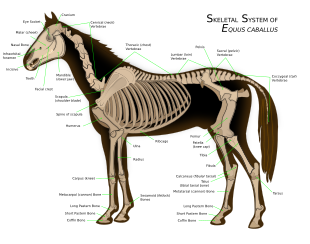
A horse's forelimbs are longer and thinner (in comparison to the rest of their body), which is necessary for running and walking on land. An alligator's forelimbs are shorter and more compact than a horse's, and can be retracted to a degree while swimming, which is necessary to move through water more easily, while still allowing them to move on land, albeit more slowly.
Both animals share a common ancestor in the lobe-finned fish. Unlike other fish, the lobe-finned fish have lobe like, scaly stalk extending from the body, resembling an early version of what would eventually become legs. This support the claim of homology by showing the difference in each of the three, with the lobe-finned fish's "legs" being there even though the fish lived solely in water and did not use the fins for any walking purpose, but those fins would eventually become the legs of both the horse and the alligator, who use them not only for different purposes from each other, but for different purposes than their ancestor, the lobe-finned fish.

The two species I've chosen for my analogous set are the duck and the platypus. A duck is a general name for a waterfowl and can include a number of species in the family Anatidae . Ducks reside in water, land, and the air, depending on whether they're swimming, walking, or flying. They have a feathered body, like most birds, which helps them with the flying. Ducks reproduce by laying eggs. Platypuses (yes, I googled the plural form of the word) reside mostly in the water, but occasionally they do come ashore to burrow, using their claws, in order to provide for safer breeding and nesting. Platypuses also reproduce by laying eggs, and this the the analogous trait they have in common (one of them, anyway).
I had initially thought of these two animals for my set because I assumed that their bills would be an analogous trait. Or at the very least, their webbed feet. I was wrong about both. Luckily, they do share one, as mentioned above, both the platypus and the duck reproduce by laying eggs. The eggs themselves, are similar in structure and shape, though the platypus eggs are smaller in size, which seems almost counter-intuitive when you consider their size being almost the same as a duck. Both use the trait to reproduce. Both developed this trait as a function to reproduce due to their main residence being a water environment, and by laying eggs they did not need to leave their unborn young to the mercy of predators in the water where they could not properly supervise them due to the adult animal's inability to "sit still" while in the water.
The common ancestor to both the duck and the platypus could have possessed the common trait of egg laying, though it is not likely since most mammals do not lay eggs. Because their species are so entirely different in terms of their species, we can assume before even doing research that this trait is not genetically related from common descent. According to recent studies, the platypus' genetic code is an eclectic brew of bird, reptile and mammal. Research has also linked the evolution of a gene in the old platypus to a mutated version in humans responsible for moving the testes outside of the body and into an external pouch, or scrotum. The duck is evolved from waterfowl, which themselves evolved from avian dinosaurs, developing bills to adjust to their dietary needs in water environments.


Hey -- Excellent work on this blog post! It is very well thought out. I like the choice to compare an alligator to a horse and I loved the small Ralph Lauren reference you dropped in there. I also really like your image choices especially the common ancestor of the horse and alligator. The whole assignment was well thought out and done very well! Great job!
ReplyDeleteHomology: Good opening description and good discussion on the functional/structural differences in the forelimb and how this is tied to environmental differences.
ReplyDeleteDo we really need to go back to archaic fish to find a common ancestor? We know that horses are mammals, who arose from reptiles. Since alligators are also reptiles, the common ancestor would be an archaic reptile, correct? And we know from the fossil record that this early reptile possessed the generalized limb structure, which was passed that onto these two descendant species, with changes concurring over time due to differences in the environment (aquatic vs. terrestrial). That is what we need to know to confirm common genetic origin and confirm homology.
Analogy: Good opening description.
I'm puzzled because all three of the traits you mention (bills, webbed feet and egg-laying) ARE analogous traits. What made you think that the first two were not? Both traits arise independently in water fowl and in the platypus, evolving after they split off from either the avian line (for ducks) or the mammalian line (for the platypus). Neither were inherited from a common ancestor.
"Because their species are so entirely different in terms of their species, we can assume before even doing research that this trait is not genetically related from common descent."
Not a safe assumption. Genetic distance is not evidence of analogy. For example, the tiny bones in our middle ear are homologous to the branchial arches of ancient fish. No kidding. So don't rely on assumptions. Rely on evidence.
In this case, we know quite a bit about the evolution of the platypus. Egg-laying is not a mammalian trait. They give birth to live young via placenta's, so the egg-laying trait would have had to have been evolved after the platypus split off from the other mammals. This makes it a uniquely derived trait and evidence that it evolved independently in the platypus, confirming analogy.
"According to recent studies, the platypus' genetic code is an eclectic brew of bird, reptile and mammal. "
Can you provide a source for this? All mammals have reptilian genetic codes because we arose from reptiles, but avians are a branch off of the reptilian line and mammals wouldn't have the unique avian DNA.
Good images.
Hey Monica!
ReplyDeleteThis is a great post! At the surface, alligators and horses look like the two most different animals in the world. One lives in the ocean and the other had been used as a means of transportation for humans for years. To see that these two animals in their vastly different environments share a homologous trait blew my mind! The forelimbs of a horse and alligator are used for entirely different things, yet they share a common ancestor! This post was very informative and had many chunks of very interesting and some surprising information!