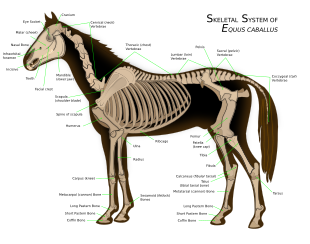
A horse's forelimbs are longer and thinner (in comparison to the rest of their body), which is necessary for running and walking on land. An alligator's forelimbs are shorter and more compact than a horse's, and can be retracted to a degree while swimming, which is necessary to move through water more easily, while still allowing them to move on land, albeit more slowly.
Both animals share a common ancestor in the lobe-finned fish. Unlike other fish, the lobe-finned fish have lobe like, scaly stalk extending from the body, resembling an early version of what would eventually become legs. This support the claim of homology by showing the difference in each of the three, with the lobe-finned fish's "legs" being there even though the fish lived solely in water and did not use the fins for any walking purpose, but those fins would eventually become the legs of both the horse and the alligator, who use them not only for different purposes from each other, but for different purposes than their ancestor, the lobe-finned fish.

The two species I've chosen for my analogous set are the duck and the platypus. A duck is a general name for a waterfowl and can include a number of species in the family Anatidae . Ducks reside in water, land, and the air, depending on whether they're swimming, walking, or flying. They have a feathered body, like most birds, which helps them with the flying. Ducks reproduce by laying eggs. Platypuses (yes, I googled the plural form of the word) reside mostly in the water, but occasionally they do come ashore to burrow, using their claws, in order to provide for safer breeding and nesting. Platypuses also reproduce by laying eggs, and this the the analogous trait they have in common (one of them, anyway).
I had initially thought of these two animals for my set because I assumed that their bills would be an analogous trait. Or at the very least, their webbed feet. I was wrong about both. Luckily, they do share one, as mentioned above, both the platypus and the duck reproduce by laying eggs. The eggs themselves, are similar in structure and shape, though the platypus eggs are smaller in size, which seems almost counter-intuitive when you consider their size being almost the same as a duck. Both use the trait to reproduce. Both developed this trait as a function to reproduce due to their main residence being a water environment, and by laying eggs they did not need to leave their unborn young to the mercy of predators in the water where they could not properly supervise them due to the adult animal's inability to "sit still" while in the water.
The common ancestor to both the duck and the platypus could have possessed the common trait of egg laying, though it is not likely since most mammals do not lay eggs. Because their species are so entirely different in terms of their species, we can assume before even doing research that this trait is not genetically related from common descent. According to recent studies, the platypus' genetic code is an eclectic brew of bird, reptile and mammal. Research has also linked the evolution of a gene in the old platypus to a mutated version in humans responsible for moving the testes outside of the body and into an external pouch, or scrotum. The duck is evolved from waterfowl, which themselves evolved from avian dinosaurs, developing bills to adjust to their dietary needs in water environments.


